🛣️Lane-Switch Gaussian Splatting Urban Scene View Extrapolation via Selective Diffusion Refinement

Tianyu Liu1, Yuan Liu1†, Bin Ma2, Kunming Luo1, Ping Tan1†
1The Hong Kong University of Science and Technology
2Meta

†Corresponding Author

Lane Switch View Extrapolation

Real-time rendering at 112 FPS

Abstract

Existing autonomous driving simulators struggle with realistic view synthesis when vehicles switch lanes, often producing artifacts or floaters. Lane-Switch Gaussian Splatting addresses this with a plugin designed specifically for lateral view extrapolation in lane-switch scenarios. Its core strength is progressive refinement: the GaussianRefiner fills in artifacts and missing content, while the Adaptive Refinement Arbiter enables selective optimization—preserving geometric consistency in high-quality regions without over-correction. No scene-specific fine-tuning is needed, it maintains real-time rendering at 112 FPS, and boasts strong generalization to unseen datasets.

Method Overview

Lane-Switch Gaussian Splatting Pipeline

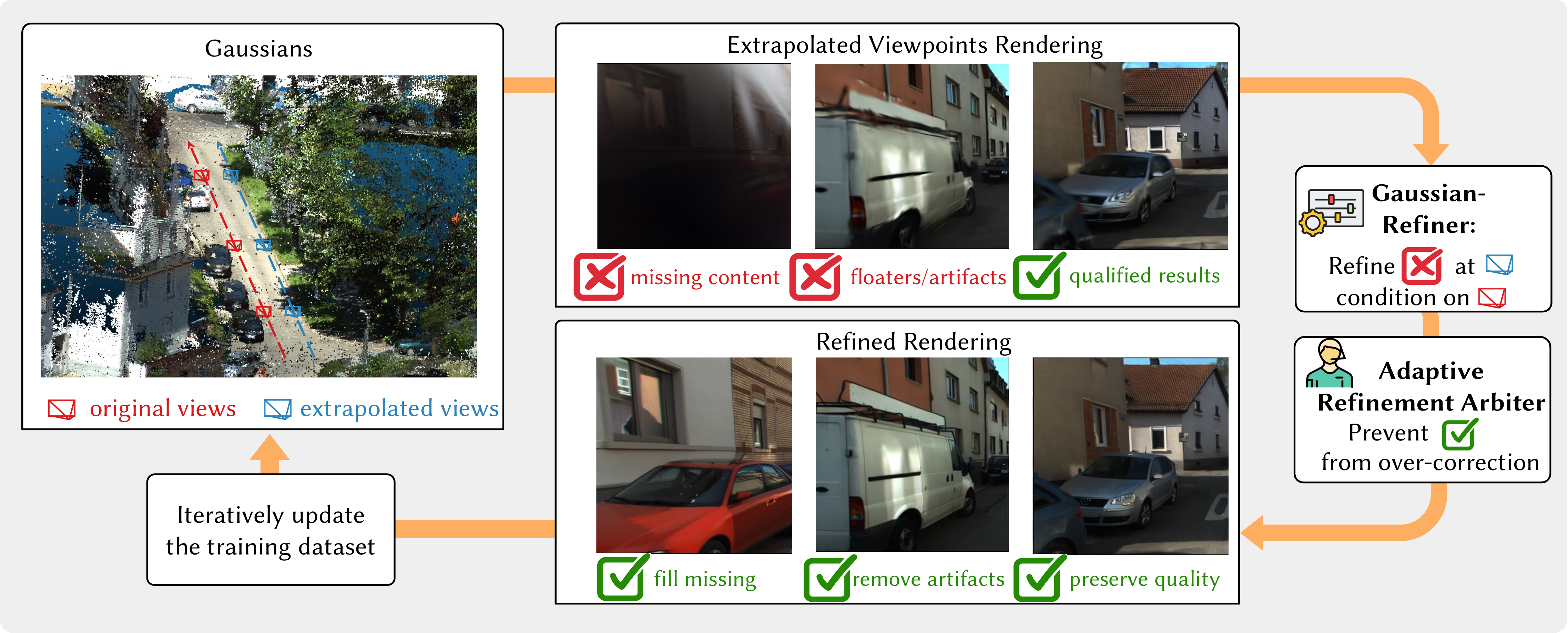
Lane-Switch Gaussian Splatting addresses urban scene view extrapolation for lane-switch scenarios. We optimize Gaussian primitives using input views (red) to synthesize extrapolated target viewpoints (blue). Direct rendering at extrapolated poses often suffers from artifacts and missing content. To resolve this, we introduce GaussianRefiner, a fine-tuned diffusion module that generates high-quality images conditioned on both rendering outputs and original training views—ensuring geometric consistency while mitigating artifacts. The Adaptive Refinement Arbiter selectively applies targeted guidance to prevent over-correction. Refined outputs are iteratively fed back to enhance rendering quality.

Visual Quality Improvement

Case 1: Full-Scale Refinement

Extrapolated Overall Poor Rendering → Complete Quality Restoration

Case 2: Selective Refinement

Extrapolated Overall Good Rendering → Keep Strengths, Fix Imperfections

Case 3: Deblurring Refinement

Blurriness from Imperfect Intrinsics/Extrinsics → Directly Improve Blurred Outputs

đź’ˇHow It Works

GaussianRefiner (GR)

GR performs dual-level refinement: pixel-aligned repair via channel-concatenated inputs (corrupted image + noise), and non-aligned feature correction through cross-attention. This ensures both geometric fidelity and semantic coherence with original training views.

Adaptive Refinement Arbiter (ARA)

ARA uses DINO-based similarity detection between reference frames and target renders. High-similarity regions leverage the rendered output to guide diffusion sampling, preserving quality. Low-similarity regions trigger unconstrained sampling to fill missing content—preventing over-correction while enabling complete reconstruction.

BibTeX

@misc{liu2026laneswitch,
      title={Lane-Switch Gaussian Splatting: Urban Scene View Extrapolation via Selective Diffusion Refinement}, 
      author={Tianyu Liu and Yuan Liu and Bin Ma and Kunming Luo and Ping Tan},
      year={2026},
      archivePrefix={arXiv},
      primaryClass={cs.CV}
}